
- Thickness is the spec that predicts performance, more than brand or tile pattern. A manufacturer's own guide states plainly: 'it's best to use the thickest mat possible for the most successful sound reduction.'
- The mechanism is absorbing motion, not blocking sound. A rubber layer gives the machine 'enough freedom to move and shake without beating against your apartment's hard subflooring.'
- Interlocking tiles beat a single mat for full coverage under a longer walking pad or treadmill, since they tile edge-to-edge without a seam gap the way a single-size mat can leave.
- This isn't 100% soundproofing. Even a thick rubber layer reduces impact noise; it doesn't eliminate it, and a genuinely heavy footfall will still be felt to some degree below.
Quick answer: A 1-in solid-rubber gym tile beats a thin foam mat under a walking pad, because thickness is the spec that predicts the noise cut, not brand or tile pattern. A manufacturer’s own guide says use “the thickest mat possible for the most successful sound reduction.” It reduces impact noise and vibration; it does not eliminate them.
If a walking pad or treadmill is the noise source, interlocking rubber gym tiles absorb the machine’s own vibration before it reaches the subfloor: go as thick as your space and budget allow, and cover the machine’s full footprint rather than just the middle.
Does thickness matter more than the brand of a rubber gym tile?
Because the mechanism is absorption, not a magic material. A rubber tile layer works by giving a walking pad or treadmill “enough freedom to move and shake without beating against your apartment’s hard subflooring,” as one flooring manufacturer’s own guide puts it. More rubber between the machine and the floor means more room for that motion to be absorbed instead of transmitted straight down.
That’s why the same source is direct about the buying decision: “it’s best to use the thickest mat possible for the most successful sound reduction,” ahead of any other spec, tile pattern, brand name, or interlocking design. A basic 3/8-in interlocking tile, like American Floor Mats’ Fit-Lock ($106.57 on Amazon, as of September 30, 2026), works and is a common, affordable choice, but a genuinely thicker, denser tile will outperform it if your space and budget allow one: Rubber-Cal’s 1-in Eco-Sport ($51.15 on Amazon, as of September 30, 2026) is solid heavy-duty rubber at well over double the thickness of a 3/8-in starter tile, not a thin foam-core mat, from the same manufacturer whose own guide is the source for the thickness advice on this page.

Interlocking tiles or one big mat under a walking pad?
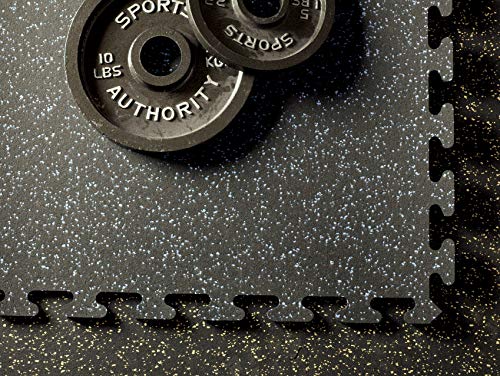
Interlocking tiles have a practical edge for a walking pad or treadmill specifically: you can lay them edge-to-edge to match the machine’s exact footprint, corner to corner, without the gap or overhang a single fixed-size mat can leave if it doesn’t match your equipment’s dimensions. For a shorter piece of equipment, or if you can find a single mat sized correctly, that works too; the interlocking format is about coverage flexibility, not a different noise-absorbing mechanism.
How do I set interlocking rubber tiles under a walking pad?
- Measure your walking pad or treadmill’s full footprint, including any overhang from wheels or a folding frame, before buying tiles.
- Choose the thickest tile your budget and space allow; thickness is the single spec the manufacturer’s own guide says predicts the result.
- Interlock tiles fully under the entire machine, not just the center, so no wheel or foot ever contacts bare subfloor directly.
- If you want a smoother top surface for walking or running, a thin non-slip mat layered over the tiles in just the equipment zone is a common refinement, not a requirement.
- Set realistic expectations: this reduces impact noise and vibration, it does not fully eliminate it, and a heavier footfall or a higher-impact use will still transmit some sound below.
What do I do if a 3/8-in tile isn’t enough for a downstairs complaint?
For impact and vibration noise from a walking pad or treadmill, interlocking rubber tiles work by absorbing the machine’s own motion, and thickness is the spec that predicts how well. A basic 3/8-in interlocking tile set ($106.57 on Amazon, as of September 30, 2026) is a reasonable starting point; if your downstairs neighbor’s complaint doesn’t fully resolve, step up to a genuinely thick, dense solid-rubber tile like Rubber-Cal’s 1-in Eco-Sport ($51.15 on Amazon, as of September 30, 2026) rather than a thicker-looking foam mat.
The same floor layer works under other quiet cardio — our upright-storage magnetic rower comparison picks machines whose makers publish rail length, storage method and noise claims.
Sources for every claim
- Rubber-Cal: Quick Fix for a Treadmill Making Noise: “greatly decreased,” “the thickest mat possible for the most successful sound reduction”
- Amazon: American Floor Mats Fit-Lock Interlocking Floor Tiles: 3/8 in solid rubber, $106.57 at check time
- Amazon: Rubber-Cal Eco-Sport Floor Tile: 1 in solid rubber, $51.15 at check time
- Floor Mat Company: Treadmill Mats for Noise Reduction: independent second source for the noise-complaint problem and the absorb-vibration mechanism
What related fixes stack with this
- The walking pad itself, ranked for a 2nd-floor apartment: our quietest walking pad guide
- A different floor-noise source entirely: our felt furniture pads guide
- Footstep noise under a rug instead of gym equipment: our rug and rug pad comparison
Questions about gym tiles and walking pad noise
Do rubber gym tiles actually stop a walking pad from being heard downstairs?
They reduce it, they don't eliminate it. The mechanism is absorbing the machine's own vibration and impact so less of it transfers directly into the subfloor. A manufacturer's own guide describes this as noise being "greatly decreased," not eliminated, and independent acoustic sources are consistent that no removable product fully stops impact noise through a floor.
Does thickness matter more than the tile brand or pattern?
Yes, according to the same manufacturer guide, which recommends using "the thickest mat possible for the most successful sound reduction" over other spec differences. A thinner interlocking tile from a premium brand will generally underperform a thicker tile from a basic one, all else equal. That also means the material matters: a genuinely thick, dense solid-rubber tile, like a 1-in option, will outperform a thin foam-core mat marketed at a similar or even greater thickness.
Interlocking tiles or one large single mat, which is better under a walking pad?
Interlocking tiles generally give better full-length coverage for a longer machine like a walking pad or treadmill, since you can tile them edge-to-edge to match the machine's footprint without a mat-size mismatch. A single large mat works fine if it's sized to fully cover the machine's footprint already.
Should I put a mat on top of the tiles too?
Some setups layer a thin vinyl-top mat over the tiles specifically in the cardio zone for a smoother, non-slip surface on top of the rubber, while the tiles underneath do the vibration-absorbing work. That's an optional refinement, not required for the core noise benefit.
Will this also help with a chair scraping or furniture noise?
No, that's a different noise mechanism (sideways dragging, not vertical impact). Our felt furniture pads guide covers the scrape-noise fix specifically; gym tiles are sized and built for impact and vibration under exercise equipment.
Sources we checked
- Rubber-Cal: "Quick Fix for a Treadmill Making Noise." Source for "By placing a treadmill noise reduction mat underneath your machine, treadmill noise will be greatly decreased," the mechanism ("absorb the vibrations of the treadmill" so the machine has "enough freedom to move and shake without beating against your apartment's hard subflooring"), and the direct recommendation: "it's best to use the thickest mat possible for the most successful sound reduction."Manufacturer · rubbercal.com · checked
- Amazon: American Floor Mats "Fit-Lock" 3/8 Inch Heavy Duty Rubber Flooring, 4' x 4' Set (ASIN B07N4B3DQL). Source for the 3/8 in thickness, solid rubber (not foam) construction and no-adhesive interlocking system. Named as the affordable starting-point tile; $106.57, in stock at check time.Retailer listing · amazon.com · checked
- Amazon: Rubber-Cal "Eco-Sport" Floor Tile, Pack of 3, 1 x 20 x 20 Inch (ASIN B00A48NF8W). Source for the confirmed 1-inch thickness of solid rubber (not EVA foam), marketed as durable, wear-resistant recycled rubber flooring, and $51.15 price at check time. Rubber-Cal is the same manufacturer already cited above for the thickness-matters claim. Named as the thicker upgrade pick; Amazon's Choice, in stock at check time.Retailer listing · amazon.com · checked
- Floor Mat Company: "Treadmill Mats for Noise Reduction." A second, independent source on the apartment noise-complaint problem this page solves ("the last thing you want while exercising is a call from the landlord or the police regarding a noise complaint from your downstairs neighbor") and the same absorb-not-block mechanism ("spreads the impact and vibrations... reducing the sound and vibrations and keeping them from being transferred").Independent · floormatcompany.com · checked